
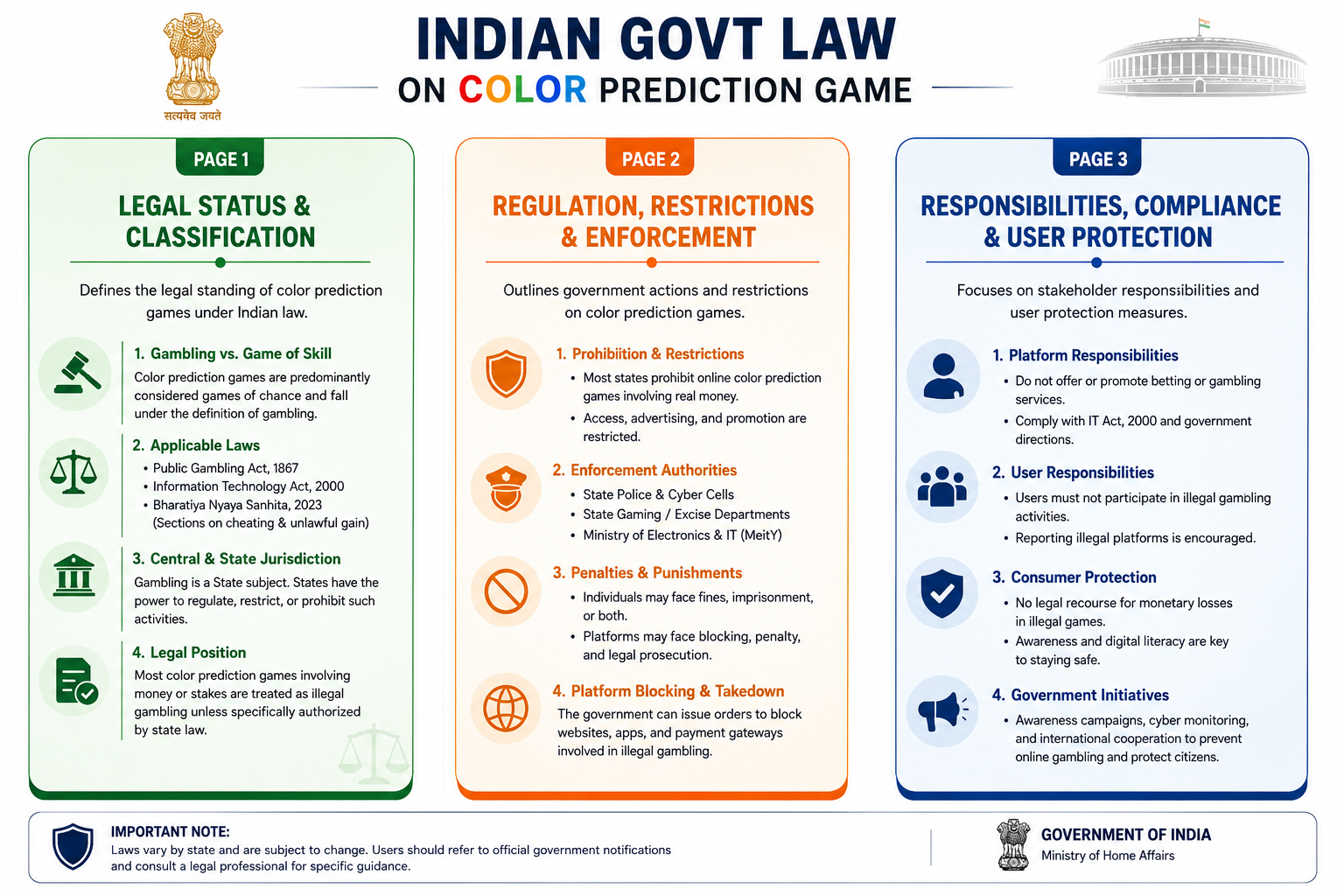
India’s online gaming industry has grown rapidly in recent years, attracting millions of users through mobile apps and digital entertainment platforms. Along with this growth, the Government of India has introduced stricter policies and compliance measures to regulate online gaming activities, especially platforms involving prediction-based formats and real-money participation.
Color prediction games have become one of the most discussed categories in the online gaming sector. Due to concerns related to financial risk, user safety, addiction, and regulatory compliance, both central and state governments have started implementing clearer guidelines for operators and users.
The Ministry of Electronics and Information Technology (MeitY) introduced a new framework under the Promotion and Regulation of Online Gaming Rules, 2026, aiming to improve transparency, player protection, and responsible gaming practices across India.
Understanding Color Prediction Games
Color prediction games are digital games where users predict a result based on predefined options such as colors, numbers, or patterns. These games are commonly available through mobile applications and websites.
In India, the legality of these platforms often depends on:
- State-specific gaming laws
- Whether the game is categorized as a “game of skill” or “game of chance”
- Real-money involvement
- Platform compliance with government regulations
Several Indian states have different interpretations regarding online prediction-based gaming activities.
India’s Online Gaming Regulatory Framework
The Government of India introduced the Promotion and Regulation of Online Gaming Act, 2025, followed by the Online Gaming Rules, 2026. The framework aims to:
- Protect users from harmful gaming practices
- Prevent illegal betting and fraud
- Encourage safe digital entertainment
- Establish a centralized regulatory system
- Improve transparency and grievance handling
The new framework also created the Online Gaming Authority of India (OGAI) to monitor compliance, classify games, and oversee enforcement actions.
Key Compliance Guidelines for Gaming Platforms
1. User Verification & KYC
Gaming platforms must implement:
- Age verification systems
- KYC verification procedures
- Identity authentication for withdrawals
- Fraud prevention mechanisms
These measures are designed to reduce misuse, fake accounts, and underage participation.
2. Responsible Gaming Policies
Platforms are expected to promote responsible gaming practices, including:
- Deposit limits
- Self-exclusion tools
- Play-time reminders
- Risk warnings
- User safety notifications
The rules focus heavily on minimizing addiction-related risks and promoting healthy gaming behavior.
3. Advertising Restrictions
Online gaming advertisements must avoid:
- Misleading earning claims
- False guarantees
- Misrepresentation of winning chances
- Promotion targeting minors
The government has increased scrutiny on influencers, affiliates, and promotional campaigns related to online gaming services.
4. Data Protection & Security
Gaming operators must maintain:
- Secure payment systems
- Data encryption
- Privacy protection measures
- User transaction records
- Complaint resolution systems
Compliance with India’s digital safety standards is considered essential for platform operations.
State-Wise Legal Differences in India
India does not have a single uniform gambling law applicable to all states. Different states regulate online gaming differently.
States with Strict Restrictions
Some states have implemented tighter controls or bans on online money gaming activities, especially games primarily based on chance.
States Allowing Regulated Gaming
A few states permit certain skill-based gaming activities under licensing or regulated frameworks.
Grey Areas
In many regions, the legal interpretation remains unclear, especially for prediction-based formats operating digitally.
Because of these differences, users and gaming operators should always review the latest local regulations before participating in or operating online gaming platforms.
Government Focus on User Protection
The Indian government has emphasized that the new online gaming framework focuses on:
- Digital safety
- Financial transparency
- Cybercrime prevention
- Youth protection
- Responsible entertainment
Authorities have also strengthened monitoring of payment gateways, VPN usage, and unregistered gaming platforms to improve compliance enforcement.
Important Compliance Measures for Operators
Gaming platforms operating in India should ensure:
| Compliance Requirement | Purpose |
|---|---|
| KYC Verification | Identity & fraud prevention |
| Responsible Gaming Tools | Player protection |
| Secure Payment Systems | Financial transparency |
| Legal Review | State-wise compliance |
| Customer Support | Dispute resolution |
| Data Protection | User privacy & security |
Challenges in the Online Gaming Industry
Despite new regulations, the industry still faces several challenges:
- State-level legal variations
- Classification disputes
- Cross-border platform access
- User awareness issues
- Enforcement complexity
Many discussions continue around the distinction between skill-based gaming and chance-based gaming activities in India.
Responsible Gaming Tips for Users
Users should always:
- Verify platform authenticity
- Read terms and policies carefully
- Avoid excessive spending
- Use gaming only for entertainment
- Follow local laws and age requirements
Online gaming should never be treated as a guaranteed income source.
Conclusion
India’s online gaming industry is entering a more regulated and compliance-focused phase. The Government of India’s Online Gaming Rules aim to create a safer digital environment while supporting responsible innovation and user protection.
Color prediction games and other online gaming formats are increasingly being reviewed under evolving regulatory frameworks. Since laws may vary across states and continue to change over time, users and operators should regularly monitor official government notifications and legal developments.
The future of India’s gaming ecosystem will largely depend on responsible platform operations, user awareness, and strong compliance with national and state regulations.